

Release 24th November 2025
Change Control note Hiperspace --version 2.5.13 HiLang --version 2.5.13
Overview
This release adds the @AlternateIndex property to explicitly create an index for views and ad hoc queries that do not or cannot be defined in the normal way of using an access path.
Path Index
Normally indexes are created in Hiperspace by defining an extent that uses an attribute to retrieve a list of elements. The following hilang model defines a Person with a Parent and an extension Children that retrieves all Person that have a Parent that refers to this person.
entity Person (Id : Guid) {Parent : Person} [Children : Person (Parent = this)];
The Children extent causes an index to be created on Parent so that access to Children is fast and does not require an scan of all Person elements
Alternate Index
The following model defines two entities {Product, Order} that can be viewed as nodes in a graph. The segment Item defined the details of the Order with reference to the Product being ordered.
entity Product = Node(...) (Id : Guid);
entity Order = Node (...) (Id : Guid) [Items : Item];
segment Item = Edges (From = owner, To = Product, FromType = "Purchase", ToType ="Purchased")
(Line : Int32)
{
  @AlternateIndex
  Product : Product,
  Quantity : Decimal
};
In a UML diagram, Order aggregates Item, and Item is associated with Product. In a Graph diagram Order and Product are both Nodes with two Edge between them for "Purchase" and "Purchased".
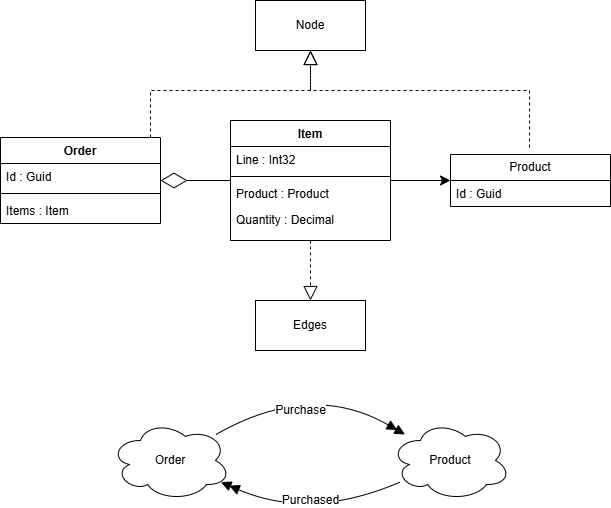
Product cannot refer to Item because it is a segment of its owner (in this case Order), and cannot therefore define a path from product to Item. When viewed as a graph the Order->(Purchase)->Product Edge uses the Item key to find all edges, but the Product->(Purchased)->Order Edge needs an @AlternateIndex to avoid a scan of all Items.
Result<> enhancement
The Hiperspace Result type has been updated to include Rust-Style continuation monads that can optionally follow a .Bind() (bind an element with hiperspace) with:
.Thenchaining function.Elseerror handling function
write.Roles
    .Bind(new Role
    {
        Name = role,
        RoleName = role,
    })
    .Then(r =>
    {
        Log?.LogInformation($"Added missing role {r.Name}");
        return Result.Ok(r);
    })
    .Else(r => Log?.LogError($"Failed to bind role {r.Value.Name} with status {r.Status} and reason {r.Reason}"));